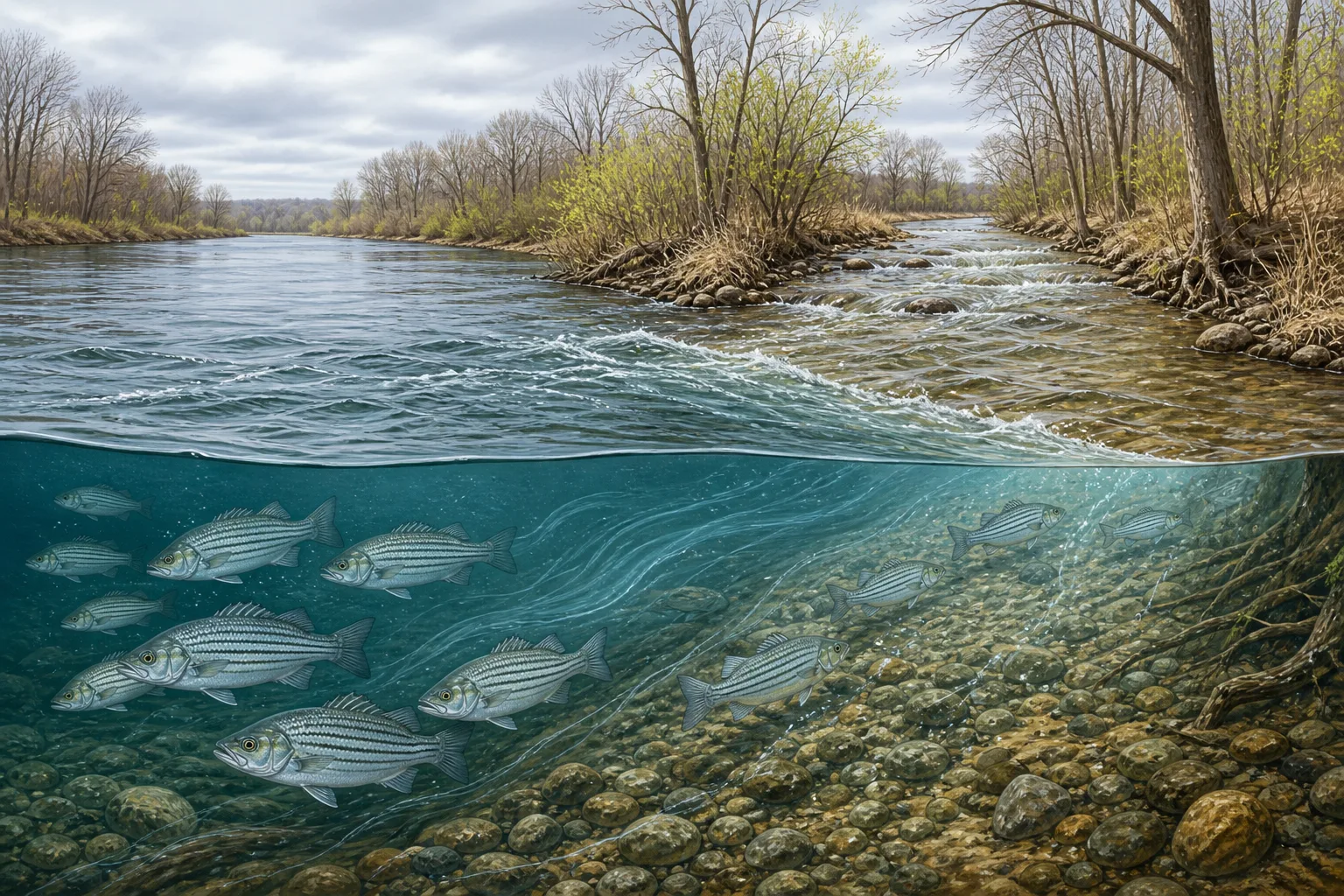
White bass run timing at a glance
| Signal | What may be happening | Where to look |
|---|---|---|
| Water near 50°F | Fish begin concentrating before the main push | Creek mouths, lower tributaries, and nearby deeper pools |
| Water in the mid-50s | Upstream movement and spawning activity can build | Flowing water over sand, gravel, and rock |
| Fresh rain and rising flow | A stronger migration cue may concentrate fish | Current seams, tributary entrances, and constrictions |
| Low or stagnant flow | The run may be slower, scattered, or prolonged | Deeper holding water near the migration route |
The calendar window is broad
Early spring is the practical Arkansas window, but latitude, elevation, reservoir depth, and weather keep it from landing on one statewide weekend. Southern or shallower systems can warm first. A cold front can pause movement. Several mild days followed by rain can change the picture quickly.
Nearby states show the same variation. Texas Parks and Wildlife describes February and March upstream movement in central Texas, while Missouri guidance places many tributary fish from March into April. Those dates help frame the season; the Arkansas Game and Fish Commission's temperature cues are more useful for an Arkansas trip.
Rain matters because current carries the signal
White bass do not move upstream because rain appears in a forecast. The useful part is what the rain does to the water: it can raise tributaries, create current, and open a more obvious migration route. Texas Parks and Wildlife notes that timely rainfall and river flow are key triggers, and that a dry spring can spread the run across a much longer period.
More flow is not automatically better. Water that jumps into unsafe conditions, turns heavily muddy, or carries debris can make access and lure control worse. Check gauges, generation schedules, road conditions, and official access notices before traveling—especially around dams and spillways.
Where fish stage before the push
Before the upstream surge, start at the transition rather than running straight to the shallowest water. A creek mouth that meets a larger river, a deeper pool below a riffle, or the slower edge beside a strong seam gives fish a place to hold while conditions develop.
Once the run builds, moving water over sand and gravel becomes more important. The AGFC explains that current helps keep spawned eggs aerated. That makes tributaries and constricted river sections logical search areas, provided they are open, legal, and safe to reach.
Match the lure to the stage of the run
When fish are gathered near a creek mouth, a small white shad imitation on a light jighead is a sensible first cast. If they spread across moving water, an inline spinner can cover more of the seam. A compact spoon earns its place when the holding water is deep or beyond light-jig range.
Our white bass run lure guide breaks those choices into four categories for current, depth, and clarity. For tailraces and heavier flow, continue with the gear guide for fishing below dams.
Choose a white bass run lureSources and research notes
- Arkansas Game and Fish Commission: White bass run spawns action across Arkansas — Arkansas temperature cues, tributary behavior, spawning habitat, and bank-access context.
- Texas Parks and Wildlife Department: annual white bass run expectations — rainfall, river flow, and the effect of dry conditions on run duration.
- Texas Parks and Wildlife Department: white bass biology — regional migration timing and flowing gravel or rock spawning habitat.
- Missouri Department of Conservation: White Bass — a northern regional comparison for spring tributary timing.
Research boundary: agency guidance describes biological patterns, not a guarantee for a specific river on a specific day. Local conditions can shift faster than a seasonal article.